
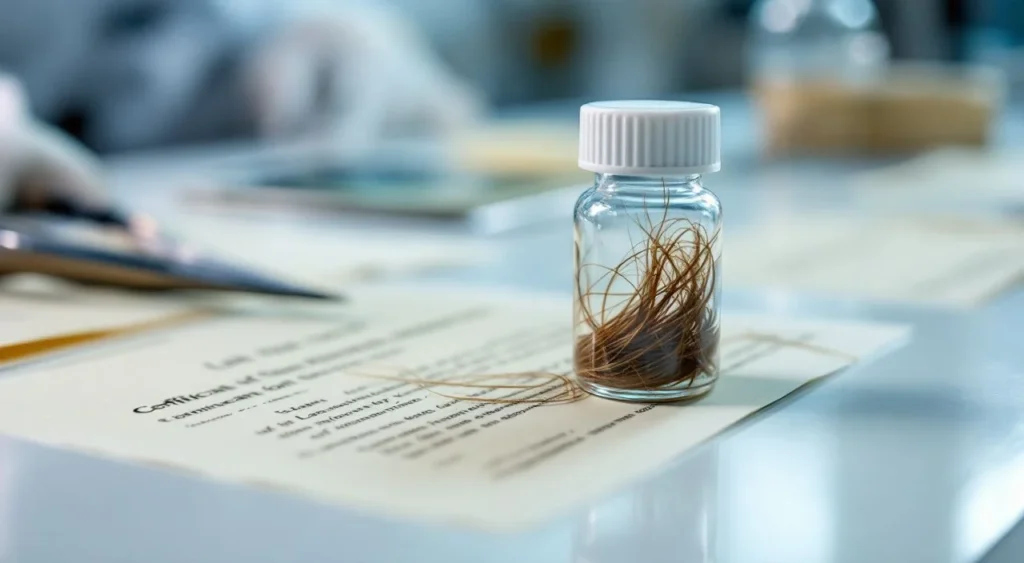
Key takeaways:
- Courts do not order drug tests in every custody case. A judge usually needs a real reason, such as evidence of substance abuse that could affect the child.
- Hair tests look back further than urine tests, but they miss very recent use. Federal health officials note that drugs do not appear in hair for about 5 to 7 days after use.
- California does not ban hair tests by name, but its custody testing law requires the least intrusive method and federal testing standards, keeps results sealed, and says a positive result alone is not enough for an adverse custody decision (Family Code 3041.5).
- A positive test is not an automatic loss of custody. Judges look at the whole picture, including what you do next.
Last reviewed: October 22, 2026. This article is general information about US law, not legal advice. Laws change and every situation is different, so talk to a licensed attorney in your state about your own case.
Your co-parent’s lawyer has asked for a hair follicle drug test, or you are thinking about asking for one. Either way, you probably want to know when a court can order it, what the test can and cannot show, and what happens with the results. This guide walks through the basics.
Contents
- When courts order drug testing
- How hair testing works and its limits
- California’s custody testing law
- How to prepare
- What happens after the results
- FAQ
When courts order drug testing
In custody cases, the judge decides based on the child’s best interests. Drug testing is a tool a judge can use when there is a genuine concern that a parent’s substance use puts the child at risk. Most states leave this to the judge’s discretion, and the rules for what evidence is needed vary.
Things that may support a request for testing include:
- A recent arrest or conviction for a drug or alcohol offense, such as driving under the influence
- Police reports, child protective services records or medical records
- Testimony from people who saw drug use or impairment, especially around the child
- Past positive tests or treatment history
An accusation alone, without anything to back it up, often is not enough. California, for example, only allows a court to order testing when it finds, by a preponderance of the evidence, habitual, frequent or continual illegal use of controlled substances or habitual or continual alcohol abuse. A conviction within the last five years for illegal use or possession can be evidence of that (Family Code 3041.5).
Which test? Courts can order urine, hair, oral fluid or other tests, depending on state law and what the judge thinks fits the concern. The type of test, who pays and which lab is used are usually spelled out in the order.
How hair testing works and its limits
As drugs circulate in the blood, traces get incorporated into growing hair. Because hair grows slowly, a sample cut close to the scalp holds a record of past use. The US Department of Health and Human Services (HHS) described the science in its 2020 proposal for federal workplace hair testing:
- Growth rate: head hair at the crown grows about 0.4 millimeters a day, or roughly 1 centimeter a month.
- Look-back period: HHS proposed testing 0.5 to 1.0 inch of head hair, which it said represents roughly 30 to 60 days. Many commercial labs test a longer 1.5-inch segment and describe it as covering about 90 days.
- Recent use: according to HHS, drugs and their byproducts do not appear in hair until about 5 to 7 days after use, so hair is not a good test for very recent use.
- Confirmation: a positive screening result should be confirmed with a more precise lab method (mass spectrometry).
Known concerns: HHS has flagged two open scientific questions about hair testing: external contamination (drug residue from the environment rather than use) and the possible effect of hair color, since melanin pigments may influence how much of a drug ends up in hair. As of HHS’s 2023 update to its federal workplace rules, hair testing guidelines had been proposed but not finalized, and no federal agencies were testing hair. If results are disputed, these issues can be raised with the court.
A hair test also cannot pin down exactly when use happened within the window, and it cannot show whether someone was impaired while caring for a child.
California’s custody testing law
You may read online that California bans hair testing in custody cases. That is not what the statute says. California Family Code 3041.5 does not mention hair or urine by name. Instead it sets these rules:
- The court must order the least intrusive method of testing.
- Testing must follow the procedures and standards HHS sets for drug testing of federal employees.
- Results are confidential and kept as a sealed record in the court file. They can only be released to the court, the parties, their attorneys and others the court authorizes, and they cannot be used in other criminal, civil or administrative cases.
- The court may order either or both parents to pay for the testing.
- A parent who tests positive can request a hearing to challenge the result, and a positive result, even if upheld, is not by itself grounds for an adverse custody or visitation decision.
Because the statute ties testing to federal standards and federal hair guidelines are not final, whether a hair test is allowed in a particular California case is a question to raise with an attorney. Other states have their own rules, and many leave the choice of test to the judge.
How to prepare
- Follow the order exactly. Go to the lab named in the order, on time, with the ID the lab requires. Delays can look like you are trying to wait out the test.
- List your prescriptions. Bring a list of medications you take with prescriptions. Some legitimate medications can show up on a drug panel, and the reviewing doctor or lab may ask about them.
- Do not use “detox” products. Trying to cheat a court-ordered test can hurt your credibility far more than an honest result.
- Keep paperwork. Save the order, the lab’s chain-of-custody form and the report.
- Ask about retesting. If you dispute a result, an attorney can ask about confirmation testing, a split sample or a challenge to the lab’s procedures.
What happens after the results
A negative result usually takes the testing issue off the table unless new concerns come up. A positive result does not automatically mean you lose custody. Judges consider all the evidence about the child’s safety and your parenting. Common responses include more testing, a substance abuse evaluation or treatment, supervised parenting time for a period, or conditions such as not using alcohol or drugs before or during parenting time.
What you do after a positive result often matters. Following the court’s orders, completing any recommended treatment and testing clean over time can help show the court that the child is safe with you. A family law attorney can advise you on the best approach in your state.
FAQ
How far back does a hair follicle test go?
It depends on how much hair is tested. HHS described 0.5 to 1.0 inch of head hair as covering roughly 30 to 60 days, and many labs describe a 1.5-inch sample as covering about 90 days. Use in the past 5 to 7 days usually will not show up yet.
Does California ban hair follicle tests in custody cases?
Not by name. California Family Code 3041.5 requires the least intrusive testing method and federal testing standards, keeps results sealed, and lets a tested parent challenge a positive result. Whether a hair test fits those rules in your case is a question for your attorney.
Can you refuse a court-ordered drug test?
You can be found in contempt for disobeying a court order, and a judge may view a refusal very negatively when deciding custody. If you object to a test, raise it through your attorney or with the court before the deadline instead of simply not going.
Does a positive test mean I lose custody?
Not automatically. Judges look at the child’s overall safety and best interests, and they often order steps like more testing, treatment or supervised time rather than ending a parent’s time with the child.
Sources: California Family Code 3041.5 (text reviewed via WomensLaw.org); HHS proposed Mandatory Guidelines for Federal Workplace Drug Testing Programs Using Hair, 85 Fed. Reg. (Sept. 10, 2020); HHS Mandatory Guidelines (urine), Oct. 12, 2023.