
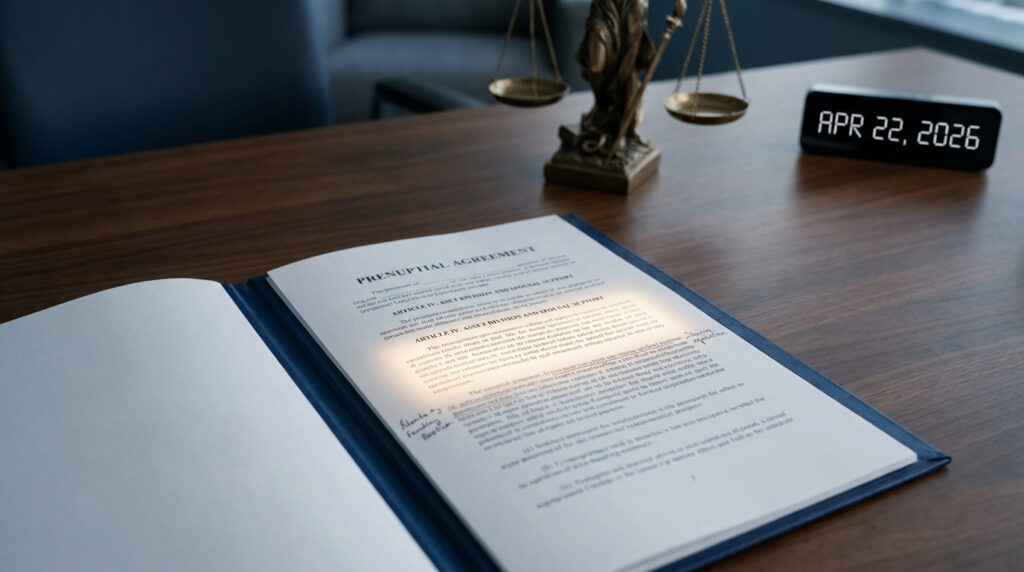
You are sitting across from your partner, picking out flower arrangements, but you can’t stop wondering what happens if the “for better or worse” part fails. It feels cold to bring up a prenup cheating clause while planning a honeymoon, but protecting your heart and your bank account is just smart planning. We are going to look at whether these lifestyle penalties actually hold up in court or if they just create unnecessary tension before you even say I do.
- The “Cheating Clause” Reality Check — What You’re Actually Signing
- Will a Judge Actually Listen? — The Truth About Enforceability
- Defining “The Act” — Drafting Language That Doesn’t Fail
- Protection or Just Paranoia? — The Emotional Cost of the Clause
The “Cheating Clause” Reality Check — What You’re Actually Signing
More couples are moving beyond bank accounts to set moral boundaries. They’re adding behavioral rules to their prenups — shifting the focus from simple math to literal moral ground.
An infidelity clause is a provision in a prenuptial agreement that imposes financial penalties for extramarital affairs.
Money meets morals — the basic definition
An infidelity clause acts as a strict financial deterrent. It is a specific provision within your marital contract. It triggers financial consequences if a spouse strays.
Modern couples now use these clauses to enforce fidelity. This shift toward behavior-based penalties changes the legal landscape of the marriage. It’s a new way to contract trust.
The goal is protecting the betrayed spouse. It secures their financial future against betrayal. It’s about emotional security through legal means.
Financial penalties vs. lifestyle expectations
Cash penalties differ from lifestyle clauses. One is about money; the other regulates daily behavior. Both aim for marital stability.
Compare lump-sum payouts to losing alimony entirely. Forfeiting future support is a massive risk. This creates a strong deterrent for high-earning partners.
These rules differ from standard property division. Standard rules ignore why a marriage ended. But a prenup cheating clause puts a price tag on misconduct.
It’s a lot to think about — but you’ve got this. Protecting yourself is always the right move.
Will a Judge Actually Listen? — The Truth About Enforceability
So, you’ve drafted the perfect agreement. But here is the cold reality—a judge might just look at your hard work and toss it in the trash. It’s not about what you signed; it’s about where you live.
The no-fault divorce hurdle in specific states
Judges in California or Hawaii often ignore your private rules. They follow state policy over your personal agreements. In these places, why you split simply doesn’t matter to the court.
In no-fault states like California and Hawaii, judges frequently refuse to enforce behavioral penalties or infidelity clauses. They view these as a violation of public policy, making enforceability a massive gamble for couples.
Many regions refuse to consider misconduct at all. They see a prenup cheating clause as a legal overreach. It turns your financial protection into a high-stakes roll of the dice.
Family law usually prioritizes equitable distribution. It hates punitive clauses that feel like revenge. Often, the law wins and the contract loses.
Why “punitive” language gets tossed in court
Courts label clauses as “punitive” when they look like a trap. Judges hate seeing one spouse financially destroyed over a mistake. It feels like a penalty rather than a fair settlement.
One bad line can sink your whole ship. Severability clauses are vital for survival. But even they aren’t always bulletproof when a judge gets angry.
A deterrent must be reasonable and proportional to work. If it’s just a massive fine, the court will ignore it. You want protection—not a lawsuit that never ends.
Defining “The Act” — Drafting Language That Doesn’t Fail
Before you get into the nitty-gritty of evidence, you have to decide what “cheating” actually means in your world. A judge won’t guess for you — they need a roadmap.
The messy line between physical and emotional betrayals
Defining emotional affairs is like trying to catch smoke. Digital interactions are hard to define legally. Vague language leads to expensive litigation later.
Contrast physical acts with digital/online interactions. Explicit definitions are needed to avoid litigation and keep things crystal clear for a judge.
Be specific about physical acts versus online cheating. Clearly state what counts as a breach. Explicit definitions protect both parties from misinterpretation. Use clear terms.
Measurable definitions are your best friend. You need a binary trigger for the clause. Avoid subjective feelings in the text.
The burden of proof — showing the receipts
You need a prenup cheating clause that actually holds up when things get messy. A hunch isn’t enough. Concrete proof is the only currency in court.
Think about private investigators or digital forensics. Photos and texts are common evidence types. Privacy laws can sometimes complicate how you gather data.
Proving fault in a legal setting is a high bar. It is a contractual environment, not just a divorce. Burden of proof rests on the accuser.
It’s a lot to think about, I know. But getting this right now means less pain later. You’re going to be fine.
Protection or Just Paranoia? — The Emotional Cost of the Clause
Bringing a lawyer into your bedroom is a whole different vibe. Before you sign, we need to talk about your heart — not just your bank account.
How these clauses impact the pre-wedding vibe
A prenup cheating clause can feel like a vote of no confidence. It often poisons the engagement period. Legal protection usually comes at a high emotional price.
Does a penalty stop a wandering eye or just breed resentment? Mutual trust is hard to build with a penalty hanging over your head. It is a heavy burden for any couple.
This request often seeds doubt before the vows. It turns a lifelong promise into a cold business transaction.
Smarter alternatives to the standard lifestyle provision
Try non-binding marital expectation documents instead. These are less litigious and softer. They focus on communication rather than punishment.
A post-nup might be better if trust is broken later. It addresses real issues instead of hypothetical fears. It is a more grounded approach to marriage.
I suggest focusing on asset protection. Behavioral policing is messy. Clean asset division is simply the smarter legal move.
Focus on clean asset division. Use non-binding documents for behavioral expectations to keep lawyers out of your private life.
You’re going to be fine. Actually — you’re going to be better than fine.
Protecting your heart and wallet is a delicate balance. While a prenup cheating clause offers a financial safety net, enforceability varies by state and requires crystal-clear definitions to survive a judge. Talk to a lawyer, weigh the emotional cost, and secure your future with total clarity.